By Nick M. Nguyen, DMD, MHA; Sarah-Ann Vu; Noah F. Nguyen
Introduction
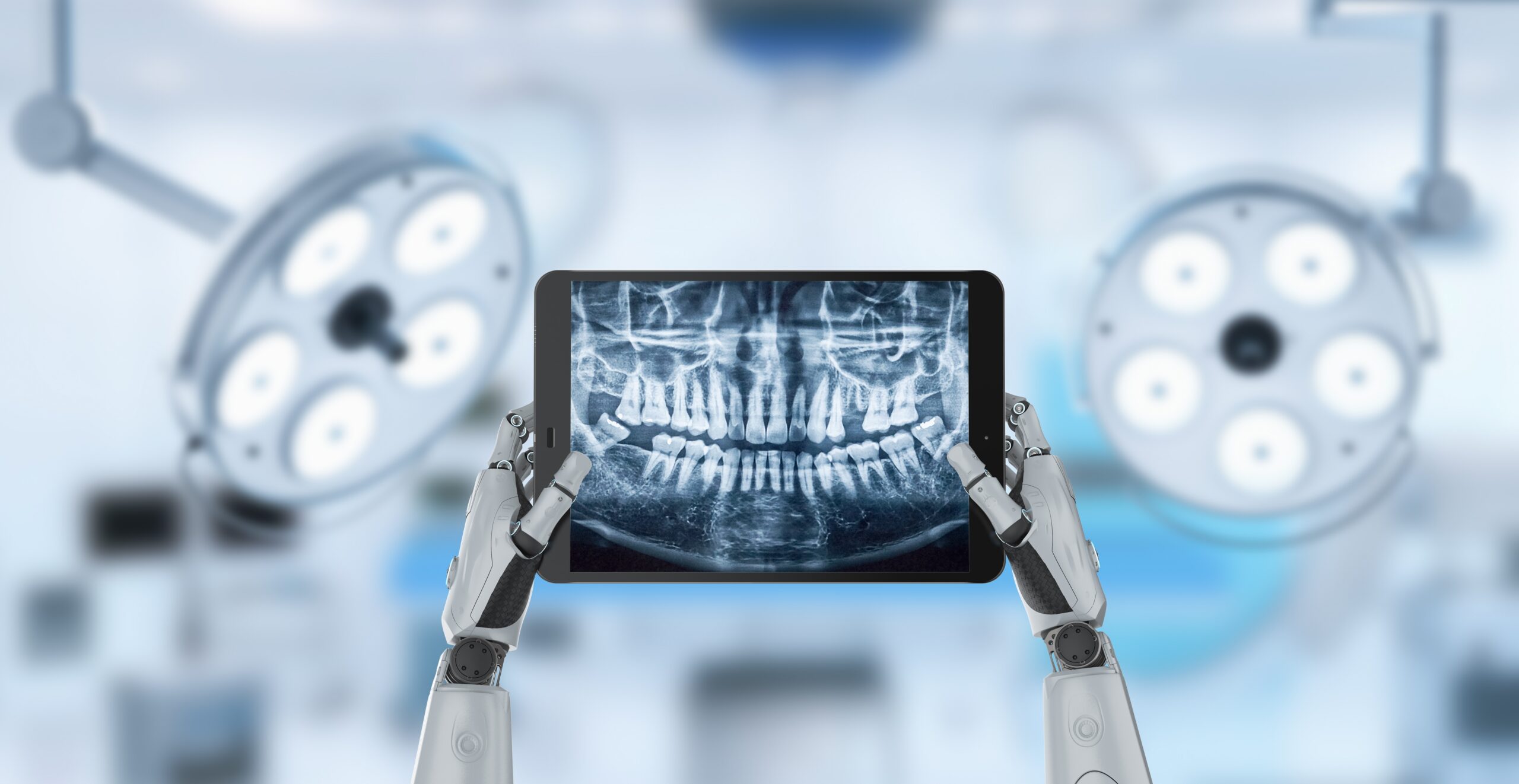
Artificial intelligence isn’t a future topic for dentistry anymore. It’s already reading radiographs in offices across Santa Clara County, and some of you may already be using it in your practice. Every week, AI flags caries on bitewings, measures bone levels, verifies insurance, and drafts chart notes while we talk with our patients. The real question for our profession isn’t whether AI is coming. It’s whether we understand it well enough to use it wisely.
To make sense of it all, we find it helpful to think of dental AI as three working models. Diagnostic AI tells us what’s there now. Prognostic AI estimates what’s likely to happen next. Generative AI creates something new, such as a crown design, an image, or a clinical note.
In the pages that follow, we’ll walk through a brief history of AI in dentistry, the concerns it raises, and where each model stands today. We’ll then share our recommendation: every dentist should understand these tools, and practices that can afford them may want to try them to see whether they help. Finally, we’ll introduce an idea we’ve been considering, a conceptual fourth model we call Hygienic AI, which focuses on how patients care for their restorations after we deliver them.
History of AI in Dentistry
The term “artificial intelligence” was coined in the proposal for a 1956 summer research project at Dartmouth. Before deep learning arrived, the “digital” in digital dentistry mostly meant computer-aided design. For example, CAD/CAM tooth libraries adjust predefined crown templates to fit a case rather than learning from data.
Things changed when deep learning met dental radiographs. In 2021, the FDA cleared Overjet to measure periodontal bone levels, and a year later it added caries detection. Also in 2021, 3Shape launched Automate, an AI-powered crown design service. Pearl and VideaHealth soon followed with their own clearances, and Videa’s testing found that dentists using its AI missed noticeably fewer cavities.
Before long, the FDA had cleared dozens of AI dental devices, most for radiograph interpretation. Then AI moved into three dimensions. Pearl and Overjet were cleared for CBCT analysis in 2025, and Velmeni followed in 2026. In about five years, AI went from a novelty to something many of us see in the operatory every day.
Problems with AI in Dentistry
Before we get too excited, we should be honest about the risks. One risk is overtreatment. In a randomized trial, dentists using AI detected more early enamel caries but also opted for invasive treatment more often. Catching a lesion earlier only helps our patients if we still manage it conservatively.
A related risk is overreliance on the software. One award-winning editorial warns that unquestioning trust in AI can dull our critical thinking and lead to misdiagnosis, and it argues that human oversight is essential. AI also doesn’t always generalize well. In one study, a model trained on radiographs from one country performed noticeably worse on images from another.
AI is changing the relationships around our clinical work, too. The same editorial notes that AI used by dental benefit plans to process claims isn’t yet well regulated and calls on payers to be more transparent. Then there are liability and privacy concerns. The Dentists Insurance Company reminds us that AI recommendations still have to meet the standard of care, and the large amount of patient data these systems require creates real security risks.
Finally, much of this technology is a black box. Most FDA-cleared dental AI devices don’t disclose the type of algorithm they use. None of these concerns is a reason to walk away from AI. Each one is a reason to keep the dentist firmly in charge.
Model One: Diagnostic AI
Diagnostic AI is the most mature of the three, and several FDA-cleared products are already used daily. It answers a simple question: what’s there right now?
On standard radiographs, Pearl’s Second Opinion reviews bitewings, periapicals, and panoramic images in real time, highlighting findings such as caries, bone loss, calculus, and defective margins. Overjet offers similar tools for caries, bone levels, calculus, and charting. In its testing, dentists found more decay with the AI than without it. VideaHealth and Denti.AI also offer cleared tools.
More recently, these tools have been applied to CBCT. Pearl’s Second Opinion 3D identifies the dentition, maxilla and mandible, inferior alveolar canal, mental foramen, maxillary sinus, nasal cavity, and airway. Overjet’s CBCT Assist measures bone levels, airway space, and distances to the inferior alveolar canal and the maxillary sinus at potential implant sites. Velmeni has also been cleared for CBCT analysis to support implant, endodontic, orthodontic, surgical, and airway review.
If you place implants near the nerve or the sinus, you can see the appeal. These tools save time and give you a consistent second look. But they locate and measure. They don’t tell us what will happen to the patient, and that’s where the next model comes in.
Model Two: Prognostic AI
Prognostic AI asks what happens next, and it’s the most active area of research among the three. We couldn’t find an FDA-cleared product whose primary purpose is to predict dental outcomes, so for now this model lives mostly in the research literature.
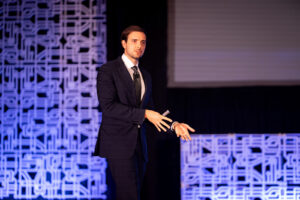
Dr. Balazs Feher of the Harvard School of Dental Medicine at the 2026 Bay Area Dental Expo
Some of the most promising work is in periodontics. Dr. Balazs Feher of the Harvard School of Dental Medicine, whose research spans diagnostic, prognostic, and generative modeling, led a study using clinical trial data to predict how individual patients would respond to periodontal treatment a year later. His team then tested the model on patients from other continents. Other groups have found that these models are better at predicting which sites will remain healthy than which diseased sites will improve, and that adding saliva biomarkers to clinical measures can help predict disease progression.
In implant dentistry, researchers have developed models that predict implant failure and peri-implantitis. What caught our attention was that one of the strongest predictors of both was simply how often patients came in for hygiene visits. In endodontics, AI can estimate, from a preoperative radiograph, whether a root canal is likely to heal. In pediatric dentistry, plaque emerged as the strongest predictor of early childhood caries. For clinicians who treat oral cancer, one model estimates, from biopsy slides, how likely a dysplastic lesion is to become malignant, performing about as well as clinical grading.
Two things stand out to us. First, prognostic AI remains fragmented. Each model predicts a single outcome for a single condition, and nothing yet integrates endodontic, periodontal, surgical, and restorative data into a single treatment recommendation. Second, patient behavior continues to emerge as a key predictor across specialties, whether it’s plaque control, hygiene visits, or compliance.
Model Three: Generative AI
Generative AI creates something new rather than analyzing what’s already there, and it’s commercially available today. One misconception is worth clarifying first: a CAD/CAM crown isn’t automatically a generative AI product.
Conventional CAD software starts with a library of standard crowns, and a technician adjusts one to fit the neighboring and opposing teeth. Generative AI works differently. It learns from examples and generates a new design. Researchers at the University of Hong Kong trained a model on hundreds of healthy natural teeth, and the resulting crowns looked more like natural teeth than conventional designs. A recent review concluded that generative design can save time and reduce manual work, potentially lowering costs.
The industry has taken notice. 3Shape’s Automate service began offering AI-designed crowns in 2021 and soon added nightguards. Generative AI extends beyond restorations. Researchers have used it to preview how a patient’s smile and face might look after orthodontic treatment and to generate synthetic radiographs for training other AI systems. Even the AI scribes that draft chart notes from our conversations with patients are generative tools.
There’s an important limitation, though. Generative AI can design the crown, but it can’t determine whether the patient needs a crown, an onlay, or an implant. That decision is still ours.
Understanding AI
We think every dentist should understand AI, whether or not it ends up in your office. Systems like Pearl and Overjet are a significant investment, and not every practice can afford them. If you can, our recommendation is to try these tools in your practice to see whether they actually help. Evidence for diagnostic AI is already encouraging, and FDA testing shows dentists detect more cavities with AI support. Prognostic AI may soon allow us to tell patients not only what they have but also how likely a treatment is to work for them. And generative AI is already saving design time in dental labs.
The risks we described earlier are another reason to understand this technology. If insurers use AI to process claims, dentists who understand how it works will be better positioned to push back against an unfair denial. If AI can overcall caries, dentists who can spot its mistakes will protect patients from overtreatment. If you bring these tools into your practice, treat AI as a second opinion, not the final word. Using them well means learning how they are trained, recognizing their false-positive patterns, documenting when you agree or disagree with them, and never letting software, an office manager, or a payer replace your clinical judgment.
The Future: Hygienic AI
All three models share something in common: they focus on the period before and during treatment. But once we seat the final prosthesis, its long-term success depends largely on what the patient does at home every day, and none of the current models address that phase. The gap is especially clear in oral cancer reconstructions, where grafted bone, irradiated tissue, limited opening, and complex prosthesis contours make standard hygiene instructions a poor fit.
We call our conceptual answer to this gap Hygienic AI. The idea is a model that draws on what the first three already know about a patient, including their anatomy, estimated risk, and the design of their restoration, to support a personalized home care plan that patients can adjust within options approved by their clinician. There’s good reason to think this could matter. How often patients come in for hygiene visits is one of the strongest predictors of implant outcomes, and AI can already assess plaque and inflammation from smartphone photos. A recent review also found that AI-enabled tools, such as a smart toothbrush paired with mobile health messages, can improve oral hygiene adherence in patients with periodontitis. A model like this might also learn from both success and failure by studying the habits of patients who keep complex prostheses healthy for years.
Picture a patient several years after a fibula free-flap reconstruction who takes a photo of the front of her implant-supported prosthesis each evening. The app highlights plaque around her anterior abutments and shows her how to angle her interdental brush. If the inflammation doesn’t resolve, it prompts her dentist to consider moving up her recall visit.
To be clear, Hygienic AI remains a concept, not a validated tool. Building it would require outcome data from many institutions, including patients who struggled and those who did well, along with prospective studies showing whether personalized guidance actually reduces peri-implant disease. It would also carry the same responsibilities we discussed earlier: clinician oversight, transparency, and patient data protection.
Conclusion
Diagnostic AI tells us what’s there, prognostic AI estimates what may happen, and generative AI helps us build the solution. Each is already changing how we practice and deserves our informed, critical attention. But our patients live with the effects of our work every day, long after the final appointment. Whether AI can truly help them during that stretch is still an open question. Hygienic AI is one way to frame it, and we look forward to exploring it further.
About the authors:
 Nick M. Nguyen, DMD, MHA, is a prosthodontist and the SCCDS Chief Communications Officer. He is currently enrolled in the MMSc program in Dental Education at Harvard School of Dental Medicine.
Sarah-Ann Vu is a senior college student majoring in Biochemistry/pre-dental at UCLA.
Noah F. Nguyen is a senior student at Saratoga High School and is applying to the 7-year accelerated dental programs.
References can be provided upon request.